This cherished, sometimes cherrypicked, verse from God’s Holy Word is not only hopeful encouragement but a somber exhortation to all who call themselves a People of God. Taken in context it is intended for those who had covenanted themselves to live as one chosen People in a land under one sovereign God; a theocracy. He will lovingly dwell among them as such, especially in one dedicated Temple. However, should they share their affections and trust in some other sovereign, and God therefore allows desperate struggle and hardship to come upon His people, “if…” If what?
3 Things – “If” such people:
- Humility – humble themselves before Him
– Change of attitude, yielding Self - Prayer – pray and seek Him only
– Change of recitation into relationship - Repentance – turn from their wicked, sinful ways
– Change of mindset, way of thinking which leads to way of right behaving
If – then.
God will hear, forgive and heal us, our land – restoration.
The charge to the Church today, brothers and sisters in Christ, no matter the land: But you are a chosen people, a royal priesthood, a holy nation, a people belonging to God, that you may declare the praises of him who called you out of darkness into his wonderful light. ~ 1 Peter 2:9 NIV. We are all called out together to shine the Light together. Do we?
Where idols and ideologies rule… This is where it gets complicated. The United States of America is a democracy (democratic republic, actually) not a theocracy. However, we who are in Christ, who call ourselves Christians who live in this land, should still take heed to such exhortation on this land! For when desperate struggles and hardship come upon us collectively (as in today), it is likely because we are not united, as “one nation under God” as we may pledge, but divided. Our worship of idols and ideologies among us have become our hope and trust, which then rule over us. Clearly, this is not at all good!
Neither good is our warring words (whose meanings change by the season), our pointing fingers (or posts), taking oppositional sides (political or theological), all for our individual “just“ causes. Can we honestly say, the mind of Christ is in this?
As Christians we conflate facts, opinions, beliefs. Unable to distinguish one from the other, these become of equal value. Then they are used interchangeably in our social interactions without awareness or sensitivity, hurting others and ourselves in the process. In our own churches we may be surprised to find that we agree with someone theologically but strongly disagree politically. Yet, we don’t feel safe to engage in further relationship, even though we are in the same church. Why?
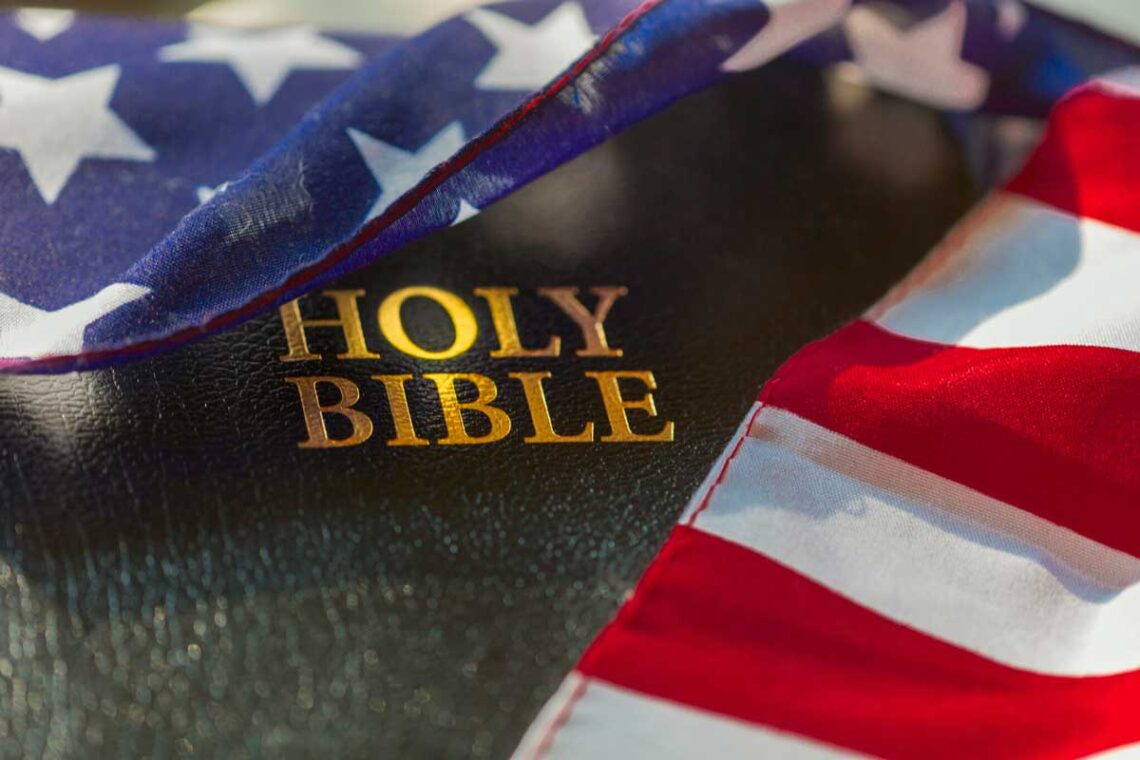
The problem is that we take something good and make more of it than we should. For example: Yes, the Bible/God’s Word is sacred. It has been purchased and preserved for us at the ultimate cost of life and blood. So too the Flag is sacred, as being purchased and preserved for us at the same cost. Both mean freedom to us; spiritual and physical. However, wrongly held in the heart each can become an idol of worship. From each can come certain ideologies that may be honorable. However, wrongly manipulated they can become justification for evil actions (by either “side”). Does this bring glory to God?
It is good to wave the Flag; yes, to honor and respect it as it represents our country of origin and citizenship. For that matter, yes, wave the Bible, as representing our source of authority and citizenship which is not of this world. Each has it’s own rightful place of the Sacred. But we must not bludgeon people with the Bible, nor wrap the Flag around it.
It is easy to confuse Patriotism and Nationalism, and no wonder! Both words are defined differently depending on the bias of their defining source. Earlier in our history those terms were used favorably as expressions of commitment and identity. More recently each has been adversely re-defined, then used in a manner of arrogant derision. At times it’s against those who passionately interpret these two words differently; defensively using them in a manner suggestive of blind idolatry. Either way, we debate and argue about words whose very definition we cannot even agree upon! The consequent divide in our churches is painfully perceptible, and dangerously concerning. As Christians in Sunday worship we may sing or say that we are one, when in actuality we are not.
• Patriotism –
Diest or Naturalist, Jew or Gentile, atheist or agnostic, each person can sacrificially die for love of his/her country equally as much as a Christian, and still be a patriot.
• Nationalism –
Civic or cultural, economic or ethnic, religious or revolutionary, political or partisan, the person passionately advocating for his/her nation’s interests or independence is still a nationalist.
As one recently observed, “It is often not clear whether Christian nationalism is referring mainly to devotion to the American nation, to the Republican Party, or to an individual politician.” This too, is confusing! Yet a Christian can be a white, MAGA supporting, Republican, or a hispanic, ACLU supporting, Democrat, and still be a nationalist. It’s complicated.
So I ask, where is “unity of the Spirit in the bonds of peace” (Ephesians 4:3), when each Christian views the other Christian person or position with contempt? Christians too often have a bad reputation for “wounding their own.” Far worse than “friendly fire,” this is intentional, motivated by idolization of one’s own ideology. In the Church where there should be unity there is disunity. Where the people would be of one accord there is discord. In or outside the Church “isms” — ideologies are not all the same — liberalism, conservatism, nationalism, socialism, capitalism, communism, even fascism. For most Christians, it’s complicated.
What is not complicated? The book of James says it best: “My dear brothers and sisters, take note of this: Everyone should be quick to listen, slow to speak and slow to become angry, because human anger does not produce the righteousness that God desires.” ~ James 1:19-20 NIV
3 Things:
- Quick to Listen – not just hear but learn
– Know the person and their position - Slow To Speak – not just react but respond
– Allow the other to be heard - Slow To Become Angry – not just about you but about them
– Discover the deeper emotions that lie beneath
These 3 may be difficult for you or me, but they are not complicated!
Anger happens to us all. We may get angry but should not be (stay) angry. When misunderstood and misused it can become sin (Ephesians 4:26-27). Anger is often a secondary “cover” emotion to more subsurface and vulnerable ones. Think iceberg.
“IF…” we the Church humble ourselves before God and one another other, pray for and seek the Lord on behalf of one another, turn from the world’s sorted way and turn to one another — even if we disagree — God will hear, forgive and heal our relationships in the land where we dwell. May we be so restored as one.
—RWO/MAST





Comments by Ric Ochsner